The Journal Record – Chickasaw Nation helps fund new $60 million heritage center in Mississippi homeland
 Patrick Sudduth
The field past the construction fence has grown tall and tangled again, and Brady Davis would like to set it on fire.
He has a reason. A few inches under those weeds sits a seed bank generations deep. Burn off the top, and the Blackland Prairie, an endangered ecosystem that once rolled across north Mississippi, comes back on its own.

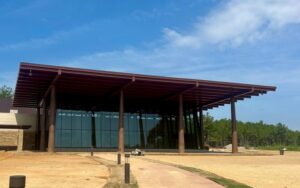
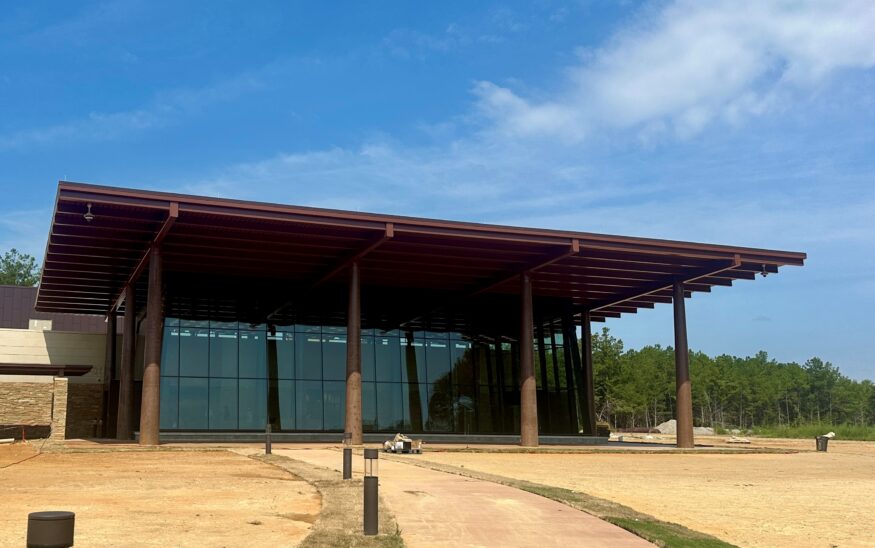
Behind Davis, a long building faces east, the way a traditional Chickasaw structure would. About a third of the money raised so far came from Ada, 570 miles away.
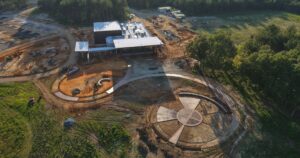
The Chickasaw Nation, which employs more than 14,500 people and reported a $5.5 billion annual impact on Oklahoma’s economy in 2024, is a major funder of the new Chickasaw Heritage Center, a roughly 160-acre campus on the Natchez Trace Parkway in Tupelo, Mississippi. The project carries a $60 million price tag, and phase one is tentatively set to open in March 2027, a date leaders say could move.
Oklahomans already know half of this project. The roughly $40 million, 184-acre Chickasaw Cultural Center opened in Sulphur in 2010. Tupelo is the other half of the story, honoring the years before removal to Oklahoma.
“Every major village until after 1800 was within 10 miles of what we’re standing on right now,” said Davis, chief executive officer of the Chickasaw Inkana Foundation, the Mississippi nonprofit that will own and operate the center. Those town sites now lie under a hospital district and a neighborhood.
A nearly empty homeland
Of the tribal nations removed to Indian Territory, the Chickasaw were among the most thoroughly displaced. Davis said the removal was so complete that north Mississippi no longer has enough Chickasaw citizens for a connection group.
That absence is part of the reason the heritage center is being built. Tupelo draws visitors for Elvis Presley and for Civil War battlefields at Brices Cross Roads and Tupelo National Battlefield. Molly Lovorn, public relations manager for the Tupelo Convention and Visitors Bureau, said visitors generally know the town sits in the Chickasaw homeland but not the extent of what was here.
Chickasaw Nation Gov. Chris Anoatubby, sworn in June 26 after his father, Bill Anoatubby, stepped down after nearly 40 years in office, framed the project as continuous with the nation’s strategy.
“The Chickasaw Heritage Center is another important milestone in our vision to be a nation of successful and united people with a strong cultural identity,” Anoatubby said. “We are grateful for the partnership with the Chickasaw Inkana Foundation and their hard work to help bring this vision to fruition. We look forward to sharing our rich history and culture in our historic homeland.”
Stacking the money
Davis said the foundation has raised about $47.5 million toward its $60 million goal, including $16 million each from the Chickasaw Nation and the state of Mississippi, roughly $3 million from local and regional donors, and interest earned on money already in hand. A $10 million federal request is pending.
Davis ran the Chickasaw Nation’s government offices in the Tupelo area from 2012 to 2019, then moved to the foundation to get the heritage center built.
“When I started in 2019, we had $50,000 in an account, and the nation was going to give $16 million for a $32 million project,” Davis said. “Then COVID hit, and now it’s a $60 million project. Our main focus now is that we have really got to get our local businesses and regional corporations to help facilitate the rest of our construction.”
The operating model splits public access from paid admission. Trails, a reconstructed 1700s Chickasaw village and a stickball field will be free, and only the exhibit hall will charge.
“This facility is going to bring in local, regional and national attention,” Davis said. “But it’s also going to be an anchor for our community, because this will be the only place in Tupelo where you can come for free, walk trails, learn something, get something to eat and spend the entire day.”
Revenue is meant to come from more than tickets. Phase 1 includes a multipurpose room that seats about 80, with a catering kitchen, plus an atrium lobby and an outdoor plaza the foundation intends to rent. Phase 2 adds a cafe and a theater seating 175 to 200. Staffing starts at about 25, a number Davis expects to look light once the doors open.
Location should help draw future visitors. The campus sits on the Natchez Trace Parkway, which is headquartered at milepost 266 in Tupelo. The parkway logged more than 7.3 million recreation visits in 2024 and ranks among the National Park System’s most-visited units.
The Oklahoma comparison
The nation already has a cultural flagship at home in the Sulphur center. The nation also helped rescue the First Americans Museum in Oklahoma City, covering cost overruns and committing $2 million a year in operating support, though the city owns and contracts out that museum.
Tupelo is meant to complement Sulphur, not duplicate it. Davis said the Sulphur campus spans several eras, while the Mississippi exhibits concentrate on the years before removal, moving visitors through creation and migration, cultural identity, European trade and sovereignty.
The last gallery is contemporary, and Davis called it his favorite piece.
“When people think about First Americans, they think teepees, headdresses and the past,” he said. “No one thinks about who First American people are today. And if you jump into who the Chickasaw people are today, it’s fascinating.”
That gallery will include John Herrington, the Chickasaw citizen who flew aboard the space shuttle Endeavour in 2002 as the first enrolled tribal member to reach orbit. Oklahoma business history runs through the same rolls. The late Tom Love, founder of Oklahoma City-based Love’s Travel Stops, was a Chickasaw citizen.
Prairie as an asset
The burn Davis wants is not sentiment. Restoring more than 30 acres of Blackland Prairie beside the largest publicly accessible restored prairie in the area gives the campus an ecological draw, a monarch butterfly program and partnerships that do not ride on ticket sales.
“This facility does more than share our culture,” Anoatubby said. “The Chickasaw Heritage Center will provide an immersive, multisensory experience, providing a unique opportunity to learn about our rich history and culture from our perspective. Additionally, the center creates partnership opportunities with federal, state and local entities relating to cultural heritage tourism and ecological restoration.
“We are excited to work with the Department of the Interior and the Mississippi Forestry Commission to restore the native, yet endangered, Blackland Prairie habitat our ancestors thrived in for generations.”
For Davis, who went to work for the Chickasaw Nation in 2012, the return is measured in something other than dollars.
“Our mission is to tell the story of the Chickasaw people from the Chickasaw perspective,” he said. “This is where we’re from. This is who we are. We want people to understand how we view ourselves culturally and our place in this world.”